Showing posts with label pellet burning stoves. Show all posts

Green Benefits of Pellet Burning Stoves

The first gas stove was patented in 1826 with the first practical coal stove being invented in 1833. After that came the invention of the first electric stove in 1891. They have certainly come a long way and there is no doubt that stoves provide efficient heating in addition to being timeless in their unique styling. Nowadays, there are numerous different styles to choose from ranging from gas, wood and even pellet burning stoves. Consequently, you are sure to find one that fits your needs and lifestyle.

The cast iron stove is one more style that is not only efficient but also extremely stylish that remains a popular choice today. Apart from their decorative and attractive traditional styles, they are also capable of using a number of different fuel types, such as coal stoves and wood burning stoves, and numerous other types of smokeless fuels. Of course, they are also able to operate as fully functioning cooking stoves and still provide efficient heating. An output of high heat is a standard feature on all of the styles and models, starting at a low of six kilowatts up to a large wattage of sixteen kilowatts, which is more than capable of heating a large room.

Wood Burning Stoves vs Pellet Stoves

Pellet Burning Stove
With everybody turning toward a greener lifestyle, there is a natural focus on what can be done to make appliances, such as stoves and fireplaces, more environmentally friendly. That is where pellet burning stoves come in, as they are extremely easy to operate and are more convenient than conventional wood burning appliances. Many folks consider that they are as easy to operate as the gas, oil or electric heaters that they are familiar with.

This type of stove burns wood pellets, which is compressed wood that is collected from what would otherwise be waste products of wood and lumber. There are also corn pellet stoves that offer the same type of environmentally friendly and simple operation as the wood pellet stoves.

Pellet Burning Stove Efficiency

Most of the pellet stoves rely on sophisticated computers and circuit boards to determine how much pellet fuel should be burned. Most models have at least two burn settings and some use thermostats to control the fire. This type of system is highly efficient and causes very little pollution.

An additional benefit to these types of pellet burning stoves is that they burn wood so efficiently that a standard chimney is not normally required. Typically, the exhaust fumes are routed through a small hole in the wall to the outside using a pipe known as a pellet stove vent. Pellet stove inserts can also be vented up through an existing chimney, but normally the chimney will need to be relined with a stainless steel liner.
Advantages of Wood Pellets for Stoves

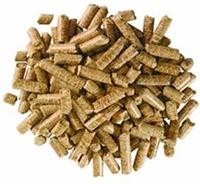
Wood pellets used as the fuel source in wood pellet stoves are made from recycled, processed and compacted sawdust and are a by-product of saw milling and other types of wood transformation processing. These pellets are extremely dense and are produced with low humidity content, normally around ten percent, which allows them to burn with very high combustion efficiency. Their uniform geometry and comparatively small size makes them ideal for automatic feeding with a fine calibration. In addition, they are perfect for feeding to a burner using either pneumatic conveying or auger feeding.

Wood Pellets for Pellet Burning StovesTheir extreme density also helps with compact storage and transportation over long distances. In fact, it is possible for them to be blown from the transport vehicle directly to the customer's storage bunker or silo on their property. Because the price of heating with fossil fuels has continued to increase, a lot of research continues to be carried out into finding other reliable sources of energy to replace non-renewable energy such as fossil fuels. To that end, production and sales of wood pellet fuel stoves and corn pellet stoves has continued to grow unabated.

Bio fuels made from bio mass or organic material have actually been proven to be effective substitutes for non-renewable energy sources. Some of these bio fuels are derived from biodegradable materials such as manure, plants, etc. However, the organic wood pellets are considered one of the best forms of wood fuel. Since they are produced through normal activities such as saw milling, or any other type of woodcutting, they are considered plentiful.

Many of the characteristics of pellets, including low humidity content and higher density, allows them to be automatically used in clean burning heating appliances. Since the pellets are considered biomass they are environmentally friendly, releasing less emissions and ashes. And, as renewable material the wood pellet offers the benefit of a continuous energy supply. There is no deliberate cutting down of trees in order to produce them. Since the pellets are actually considered waste materials, utilizing them as an energy source lessens the problem of waste and waste disposal.

With the increasing costs of fossil fuels it is only natural to turn toward other forms of heating and the pellet stove models have become increasingly popular. The stoves that are specifically designed for wood pellets do have advantages over other types of home heating systems. The normal wood burning stoves require constant maintenance compared to the wood pellet fireplaces stoves. They are also much easier to operate and are more convenient than the traditional wood fireplaces and stoves. Although the physical appearance is similar to the traditional stoves that burn wood, these have microprocessor controls that ensure a clean and efficient fire.